
The Hidden Cost of Not Archiving
Introduction
For over two decades, I’ve guided global enterprises across manufacturing, retail, BFSI, and utilities through SAP data growth, performance bottlenecks, and complex OpenText archiving landscapes.
And here’s the hard truth:
The biggest threat to a successful S/4HANA transformation isn’t code, customizations, or integrations — it’s unmanaged data.
Too often, organizations treat archiving as “technical housekeeping,” something to worry about after go-live. This mindset is why many S/4HANA programs overshoot budgets, stall, or fail outright.
This article explores the hidden cost of not archiving, the critical role OpenText plays, common pitfalls, and a proven framework that ensures your transformation is future-ready, compliant, and cost-efficient.
SAP Data Growth: The Silent Performance Killer
Enterprise data is exploding.
- Structured SAP data doubles every 18–24 months.
- Unstructured content — PDFs, invoices, CAD drawings, HR files — grows even faster due to OCR, IoT, and automation.
I’ve seen ECC systems grow from 8–10 TB to 14–18 TB without any archiving strategy. When such bloated landscapes are migrated to S/4HANA:
- HANA memory sizing explodes
- Cloud consumption skyrockets
- Migration run times stretch beyond tolerance
- Downtime cripples business continuity
- Fiori app performance collapses
These aren’t “S/4HANA problems.” They are data problems caused by not archiving early.
Why Archiving Must Start Before Migration
Every S/4HANA roadmap should begin with archiving, not end with it.
Key Benefits:
- Reduce System Size by 30–70%: Archive logs, workflows, attachments to shrink the database footprint. This can save $1–3M in HANA memory sizing.
- Accelerate Migration Timelines: Archiving early leads to 40–60% faster SUM/DMO runs, significantly reducing downtime.
- Boost SAP Performance: Smaller tables result in faster Fiori apps, CDS views, MRP runs, and reporting.
- Avoid Migrating “Technical Junk”: Change logs, obsolete tables, and workflow histories should be archived instead of carrying dead weight into your new system.
OpenText’s Role: Beyond Simple Storage
Modern enterprises generate massive volumes of unstructured content: invoices, POs, contracts, HR files, engineering drawings, plant maintenance images.
OpenText is mission-critical because it provides:
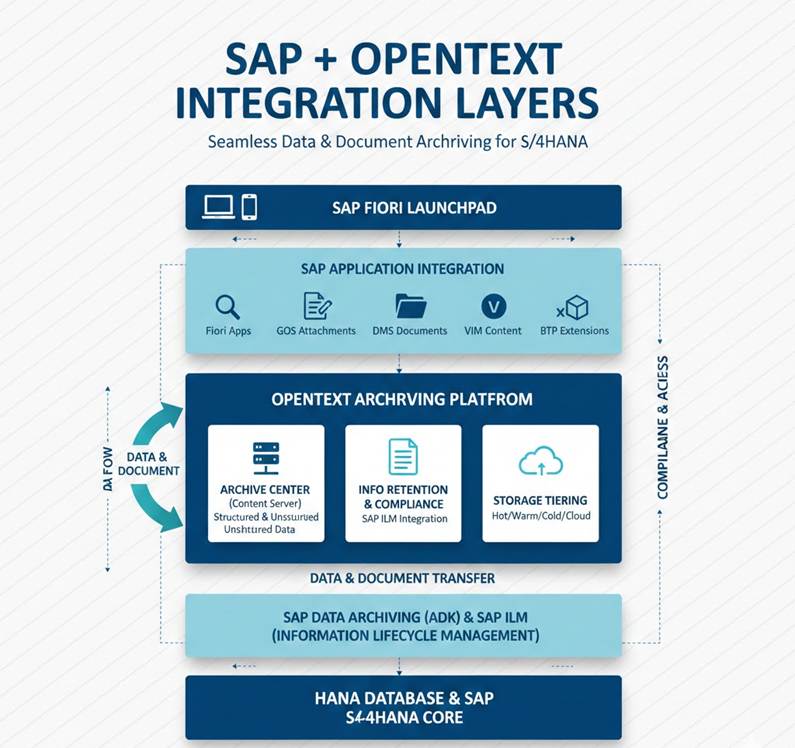
- SAP-Integrated Storage: For GOS attachments, DMS docs, VIM content, CAD drawings, spool lists.
- Retention & Compliance: SAP ILM + OpenText ensures audit-ready governance.
- Storage Tiering: Hot, warm, cold, and cloud object storage for optimal cost management.
- S/4HANA Integration: Seamless with Fiori, BTP extensions, xECM, VIM 7.6+.
Here’s how SAP and OpenText seamlessly integrate:
Common Pitfalls (Seen in 100+ SAP Landscapes)
Through extensive experience, I’ve identified recurring patterns that sabotage archiving efforts:
- Archiving starts too late (post-UAT or post-go-live).
- Business is not involved (no ownership of retention/compliance decisions).
- Missing ILM policies leading to audit failures and legal exposure.
- Attachments & GOS explosion inflating the database by TBs of PDFs/images.
- Non-SAP content ignored (CRM, BW, APO, Hybris, legacy ERPs).
- VIM tables left unarchived, leading to hundreds of GBs of growth per year.
A Proven Archiving Framework (20+ Year Playbook)
Phase 1: Discovery & Profiling
- Data volume analysis, table growth statistics, attachment review.
- Deliverables: Top 50 tables, aging analysis, priority roadmap.
Phase 2: Design
- ILM policies, OpenText Archive Center architecture, storage tiering.
- Document access strategy for Fiori, retention labeling.
Phase 3: Execution & Optimization
- High-volume archiving, DMS/GOS cleanup, VIM archiving.
- Workflow & change document cleanup, indexing, multiple test cycles.
Phase 4: Continuous Governance
- Quarterly archiving, ILM enforcement, purging rules.
- Regular business sign-off to prevent future bloat.
Tangible ROI of Archiving Done Right
The benefits of a proactive archiving strategy are clear and measurable:
- 30–70% Database Reduction: Leading to significantly lower HANA/cloud costs.
- Faster S/4HANA Conversion: Resulting in reduced downtime and a smoother cutover.
- 20–40% Performance Boost: Delivering faster transactions, reporting, and analytics.
- Full Compliance: Meeting GDPR, SOX, tax, and industry regulations.
- Lower Storage Costs: Through effective tiering and cloud optimization.
- Better User Experience: Ensuring faster document retrieval and higher satisfaction.
The Future: Intelligent, AI-Driven Archiving
We’re entering the era of Intelligent Archiving, where technology will further enhance efficiency and compliance:
- Auto-classification of documents
- Predictive retention & automated legal holds
- Semantic search & risk-based disposal
- AI-led exception classification (VIM, workflows)
- MLOps-driven content analytics
Early adopters of these intelligent solutions will lead in digital transformation maturity.
READY TO ACCELERATE YOUR TRANSFORMATION?
We position ourselves not just as a vendor, but as a trusted partner committed to delivering value, aligning with your business objectives, and building long-term relationships. Our ability to deliver tailored solutions and offer best-in-class managed services will reduce your operational overhead and ensure a successful digital future.
Let’s build your clean-core, cloud-first future.